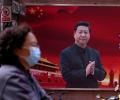
China has not limited the 'battle' to the diplomatic field alone; the People's Liberation Army has become aggressive on the ground too. The recent 'fights' in Northern Sikkim and Ladakh are part of the pattern, asserts Claude Arpi.
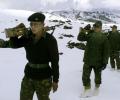
'The situation in Doklam has plateaued; militarily, the Chinese know they can do nothing here,' an Indian general tells Ajai Shukla.

The Indian Navy has just one aircraft carrier. The INS Vikramaditya carries just 26 unreliable MiG-29 fighters and 10 helicopters -- an insufficient capability to battle a serious foe.

The IAF chief also said Pakistan has become a pawn of Chinese policy and its dependence on China would increase further in future. He said India needs to understand the interplay of some major events in its vicinity that would impact the security scenario of the region.
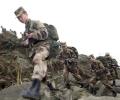
Twenty Chinese soldiers, who had last week entered Indian territory near the Line of Actual Control and pitched their tents in the Chepzi area in Ladakh, have returned after a flag meeting between the two sides, sources said on Monday.

'China's moves are of direct significance to India, which will closely monitor Chinese naval activity in the Bay of Bengal and the Indian Ocean not least because of Chinese maps depicting claims over the Andaman and Nicobar Islands.'
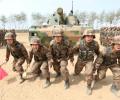
Last year, the country's defence budget was $175 billion.

India is committed to further developing friendly and cooperative relations with China, says Parrikar in Beijing.
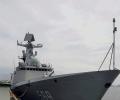
China's Navy wants to join hands with India to maintain security of the Indian Ocean

'New Delhi showed itself willing -- at least for a period -- to tolerate the risk of conflict and to withstand Beijing's implicit and explicit threats.' 'But it also continued to try to cut some kind of deal with China to reduce tensions.'
The massive square became famous all over the world with an iconic picture of a young man standing before a row of battle tanks in a bid to stop them.

Chinese President Xi Jinping has bestowed special honours on a PLA battalion posted in Tibet close to Arunachal Pradesh for its "outstanding performance in safeguarding borders".

The Chinese Communist Party's all important 19th Party Congress is just months away, and President Xi Jinping finds himself confronting unlikely challenges to his pre-eminent position, says former RA&W officer and China watcher Jayadeva Ranade.

Prime Minister Modi made a strategic blunder of Nehruvian proportions -- presuming no war can happen now, and the Chinese won't be a military threat and risk their economic interests, observes Shekhar Gupta.

'Despite the current tension at Doklam and the risk of escalation on the Himalayan land frontier, it is the Indian Ocean we need to worry about more,' says Nitin Pai.

Markets, banks, business establishments and educational institutions were closed and transport services were suspended.
After the Ladakh fiasco where Xi Jinping did not expect the Indian Army to resist his land-grabbing tactics, he has to save face before his colleagues in the Communist party.' To bring the threat of a mega-dam to the northern Indian border is a clever move, observes Claude Arpi.

Arpi deserves to be complimented for the commitment and hard work that have gone into this production. The frustrations of seeking reliable documentation from the catacombs of the Indian bureaucracy did not deter him from going after the best information available, and the result is one that he can take much satisfaction in. Ambassador Prabhat P Shukla, Member Advisory Council, Vivekananda International Foundation, reviews Claude Arpi's The End of an Era: India Exits Tibet.

India and China met and spoke a lot this year, but failed to produce any meaningful results.

The photo published by the People's Liberation Army Air Force showing a long-range strategic bomber flying within visible range of Yushan, Taiwan's highest mountain, has caused great concern in Taiwan amid debate about whether the mainland will reunify the island by force, state-run Global Times reported.

The seventh Tibet Work Forum was held in Beijing on August 28 and 29. Delhi should be deeply concerned, at a time India faces a precarious situation in Ladakh, because the TWF also defines China's western border policies, observes Claude Arpi.

India needs to be alert on how the Doklam standoff plays into the factional infighting in China's Communist Party, says Ambassador Shyam Saran, the former foreign secretary.

Outgoing Army Chief Gen Bikram Singh on Thursday said that India had given a befitting reply to Pakistan after the beheading of an Indian soldier by Pakistani troops in 2013 along the Line of Control even as he did not rule out the possibility of skirmishes on the western front in future.

'Why did your generals try to grab a few square kilometres of Indian territory in Ladakh?' 'And what happened to the hard work that you and Prime Minister Modi put into the Wuhan and Mamallapuram meets?' Claude Arpi writes a letter to Xi Jinping, China's self-styled supreme leader, who turns 68 today, June 15.
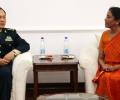
'In the case of an India-Pakistan confrontation, the Chinese may undertake more than just posturing, thereby constraining us from deploying adequate forces for decisive results,' warns Brigadier S K Chatterji (retd).

The bogey of the 1962 defeat must be laid to rest with a finality that is unquestionable. The myth of Chinese invincibility is a tall tale that belongs to an era gone by, says Vivek Gumaste.

It also dismissed Jaitley's remarks that India of 2017 is different from what it was in 1962, saying China too is different.
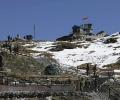
The government on Friday expressed deep concern over China constructing a road in the disputed Doklam area near Sikkim
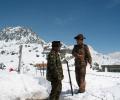
Against the backdrop of recent incursions by the Chinese troops, India and China on Saturday held a flag meeting in eastern Ladakh where the Indian side is understood to have raised concerns over detention of its nationals by the People's Liberation Army.
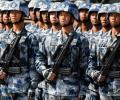
While China's nationalistic tabloid Global Times said India should be taught a 'bitter lesson', another official newspaper, China Daily, said India should look in the mirror.

'After a strategic pause though, Beijing will revive its policy of slowly creeping towards acquiring sovereignty over the South China Sea.'

'China's growing nexus with Pakistan and the two countries' unresolved territorial disputes with India continue to pose a formidable national security threat to India,' says Brigadier Gurmeet Kanwal (retd).

'If the situation escalates, then mini-scale firing might happen.'

'How and if India retaliates will go a long way toward determining the trajectory of this crisis.'

Chinese President Xi Jinping has announced that the 2.3 million strong People's Liberation Army, the world's largest, will be trimmed by three lakh.

China said it was committed to peace and tranquility at the border areas.

'The separatist resurgence in Balochistan is thwarting Pakistan's plans to build CPEC projects to optimally utilise Balochistan's energy reserves,' points out Brigadier Gurmeet Kanwal (retd).

The arrival a couple of days ago of a Chinese nuclear submarine for the first time in Karachi port, coinciding with a Chinese military delegation's visit, points to Pakistan's importance for China, says former R&AW officer Jayadeva Ranade.

"Don't expect miracles in resolving the issue. What we are trying is that till a satisfactory solution on boundary issue is found, whenever incidents take place on border, through discussions and official mechanism, resolve those issues. Of late, we have been able to resolve the issues without much delay. That is an improvement," Defence Minister AK Antony said.
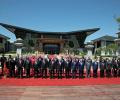
'Whichever option India chooses, it should be clear to the government that the China-Pakistan nexus poses a clear and present danger to national security,' says Brigadier Gurmeet Kanwal (retd).
 © 2026 Rediff.com - Advertise with us - Disclaimer - Privacy Policy - Sitemap - Feedback - About us - Terms of use - Grievances